
AI Startups Add $1 Trillion in Value as VC Funding Surges


AI Startups Add $1 Trillion in Value — What That Means for the Infrastructure Era
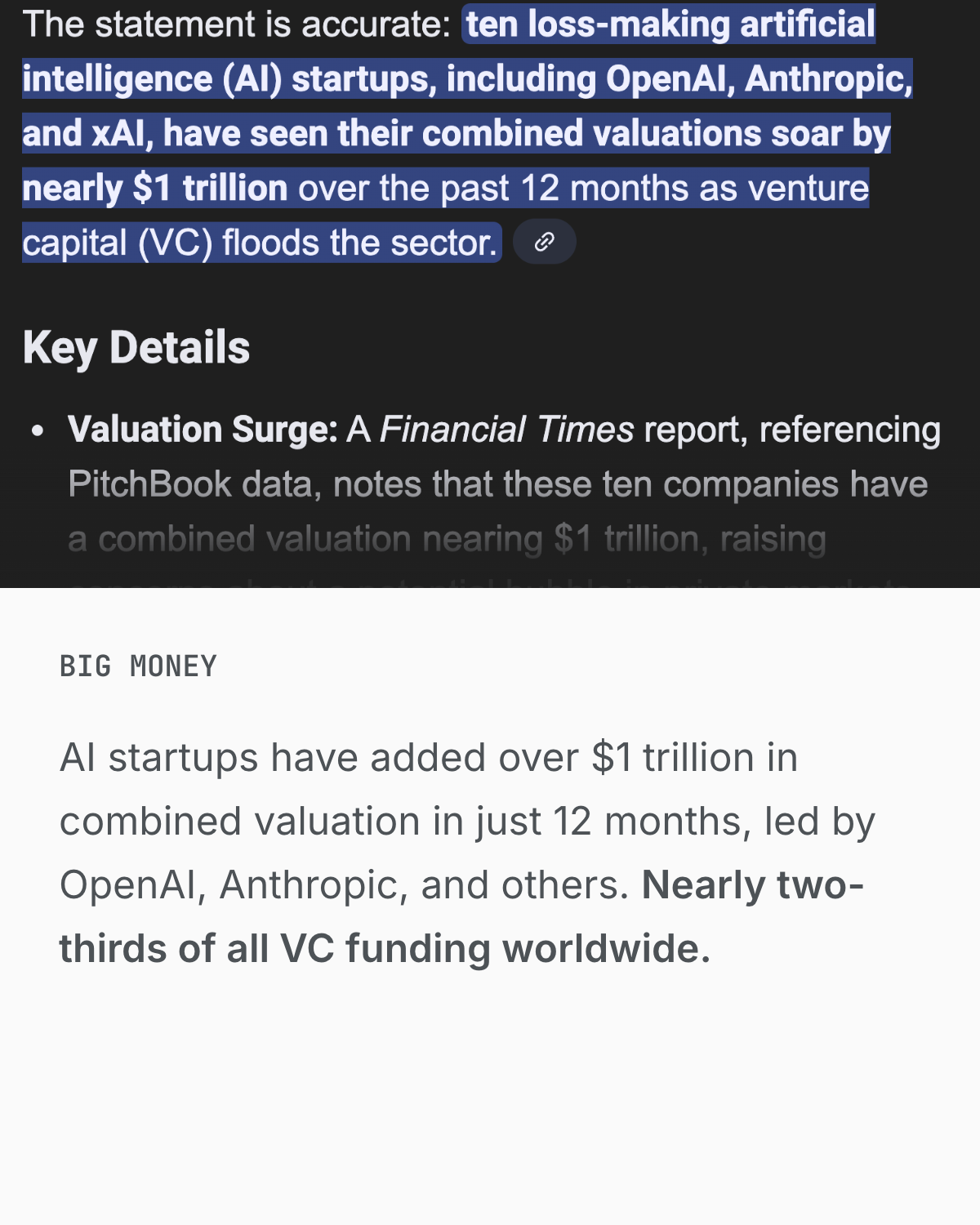
Over the past twelve months ten emerging artificial intelligence companies — including OpenAI, Anthropic, and xAI — have seen their aggregate valuations surge by approximately $1 trillion, even while most remain unprofitable. Business Standard+2AInvest+2
Venture capital flows have poured into AI in a way that now accounts for roughly two-thirds of all VC funding in some markets. Business Standard+1
This dramatic shift reflects a transition from “apps built on the cloud” toward “models built on the infrastructure of models.” Investors are treating these companies not just as software startups but as the foundational platforms for an entire re-architecting of computing. The implication: the highest valuations are going to the players building the compute, data pipelines and model-scale economies — not simply the next consumer app.
Yet the magnitude of the valuation leap raises serious questions about timing and sustainability. Analysts warn that many of these companies are trading on “future promise” rather than current performance. Survey data shows some AI startups commanding valuations 50 × revenue or more — reminiscent of prior tech bubbles. AInvest+1
For executives in enterprise retail, e-commerce and omnichannel operations this matters because the infrastructure layer is shifting. What you once treated as a backend stack is now a strategic investment core. The firms building foundational models may become the “AWS or Microsoft Azure” of the next decade. Failing to align your data, metadata and integration strategy with that shift means you risk falling behind.
From a content-and-commerce perspective the lesson is clear: if you ignore the metadata title, alt text, structured feed integrity or API-first model embed you’re not just losing ranking — you’re failing to build on the architecture that the next generation of AI infrastructure expects. That’s precisely the theme of our lesson on “Accuracy Drives Sales” at EKOM, where we show how foundational data errors ripple outward in an AI-first stack.