
Page Speed Drives Purchase Behavior

Abstract
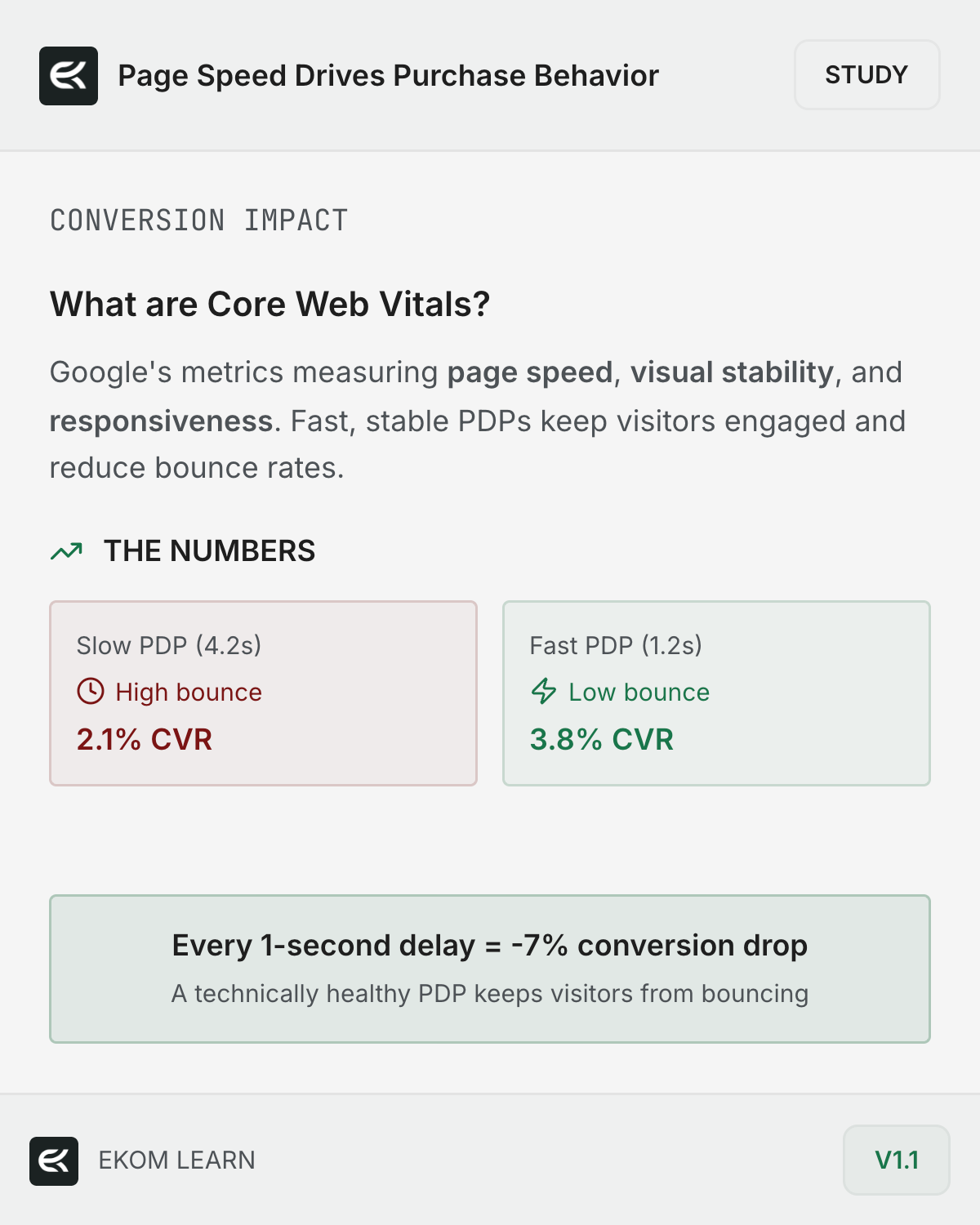
This study examines how page performance, specifically load speed and Core Web Vitals, impacts conversion rates across product detail pages (PDPs). Data collected from multiple e-commerce sites shows a direct correlation between technical stability and sales performance. Fast, stable, and responsive PDPs reduce bounce rates, improve engagement, and increase completed transactions.
Methodology
Two sets of PDPs were compared using Google’s Core Web Vitals benchmarks:
Underperforming PDPs – pages with poor LCP (Largest Contentful Paint), CLS (Cumulative Layout Shift), or INP (Interaction to Next Paint) scores.
Optimized PDPs – pages meeting or exceeding Google’s “Good” thresholds across all metrics.
Each PDP group was observed over identical timeframes, with key metrics measured including bounce rate, average session duration, and conversion rate. Google PageSpeed Insights and Search Console data were used for validation.
Findings
Optimized PDPs consistently showed stronger engagement and conversion outcomes:
- Bounce Rate: Reduced by 18–30% on faster pages.
- Conversion Rate: Increased by up to 22% when LCP and INP met “Good” thresholds.
- User Perception: Visitors stayed longer and interacted more when visual stability (low CLS) prevented layout shifts.
These results confirm that even modest performance gains, such as reducing load time by one second, can lead to measurable improvements in purchase behavior and brand trust.
Conclusion
Page speed and Core Web Vitals compliance directly influence conversion rate. A technically healthy PDP ensures smooth visual loading, quick interaction readiness, and stable layouts, all key factors in preventing bounce and improving sales.
In effect, performance is persuasion.
Fast, responsive, and stable experiences translate to higher engagement and stronger conversion outcomes.
Clean performance drives conversion.