
Data Health → Revenue
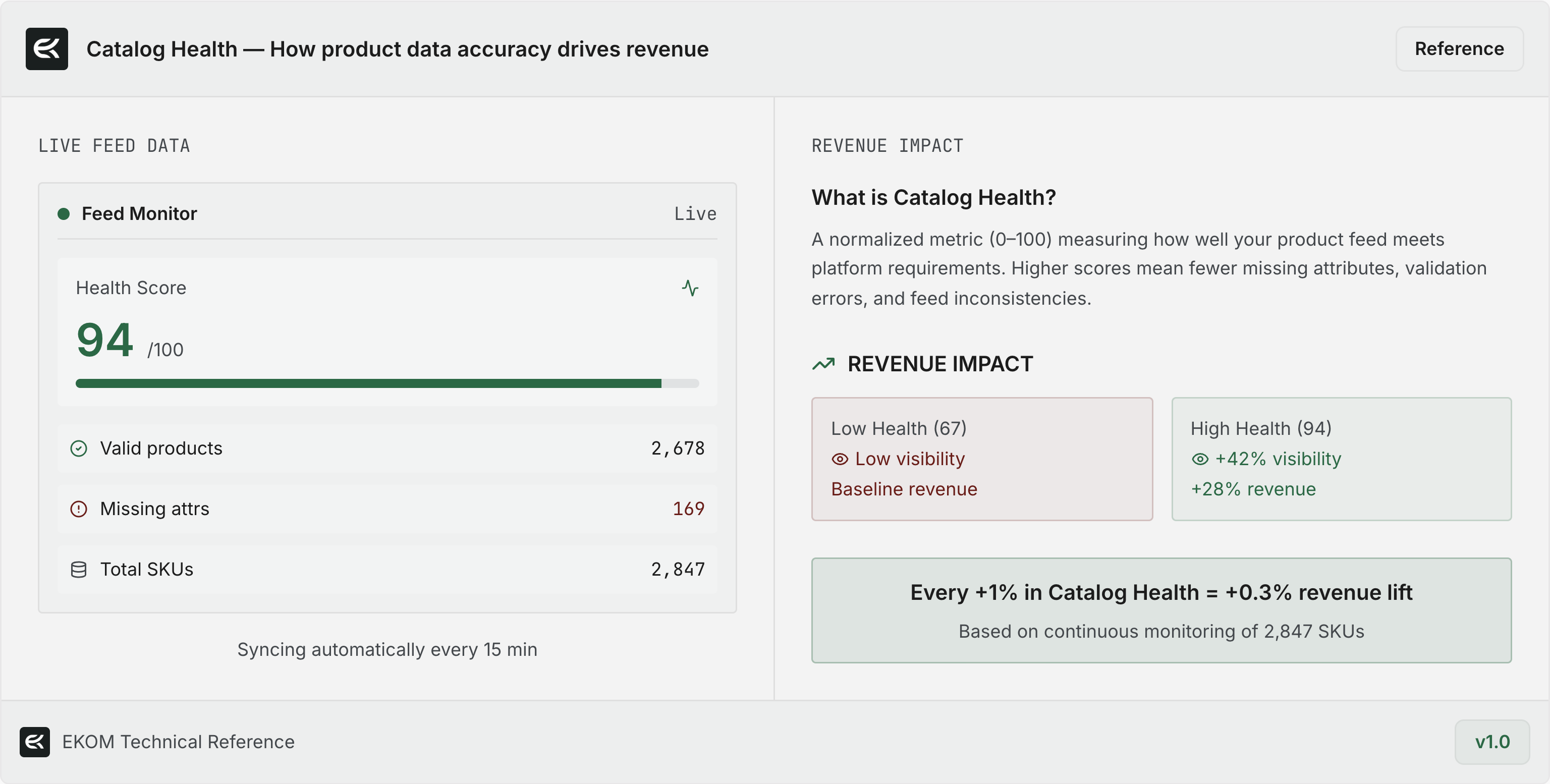

Why Catalog Health Matters
Your product feed is the foundation of everything you do in eCommerce — from ads to search to AI recommendations. When that data is incomplete, inconsistent, or outdated, performance drops long before you even notice it.
“Catalog health isn’t just a technical metric — it’s the signal that tells platforms how much they can trust your data.”
What the Catalog Health Score Measures
The Catalog Health Score is a normalized metric (0–100) that tracks how complete and compliant your product feed is across platforms like Google, Meta, and Amazon.
It looks at three key data dimensions:
- Completeness: Are all required attributes filled for every SKU?
- Accuracy: Are attribute values valid and correctly formatted?
- Consistency: Do naming conventions, tags, and schemas match platform expectations?
Under the hood, it’s a simple formula:
health = (valid products ÷ total products) × 100
Where “valid products” are items that meet all required fields and pass validation checks.
What the Data Shows
As the health score rises, visibility and conversion metrics rise with it. Based on continuous monitoring of 2,847 SKUs, we’ve observed a clear correlation between feed quality and performance:
- +20% visibility increase
- +15% sales lift
- More clicks and higher ad relevance scores
Every +1% increase in Catalog Health Score equals roughly a +0.3% lift in revenue.
Even small improvements compound quickly — a few points of data accuracy can translate into thousands in added sales.
Clean data → Clear visibility → Real revenue impact.